
Prepared by: Ammar Kannawi
Translated by:Wael Alokla
The ancient city of Aleppo, listed as a UNESCO World Heritage Site, is one of the oldest historical cities in the world, dating back to the 3rd millennium BCE. It is renowned for its iconic citadel and characterized by its Islamic heritage, reflected in its mosques, markets, and caravanserais. The city also houses several archaeological and historical museums. However, these antiquities have been heavily affected during the war in Syria, suffering brutal bombing and destruction.
During previous phases of the conflict, Aleppo experienced significant damage due to heavy shelling, especially during the period when the opposition forces controlled parts of the city, particularly the eastern areas and much of the old city. This prompted UNESCO to place the city of Aleppo on the List of World Heritage in Danger in 2013.
In 2016, however, regime forces managed to fully regain control of Aleppo after bloody battles and bombings that caused widespread destruction to the city’s cultural heritage. Extensive damage affected large parts of the city’s markets, historical buildings, and museums, with Aleppo’s iconic citadel also sustaining harm. (Picture 1)

- Liberation of Aleppo 29. Nov 2024
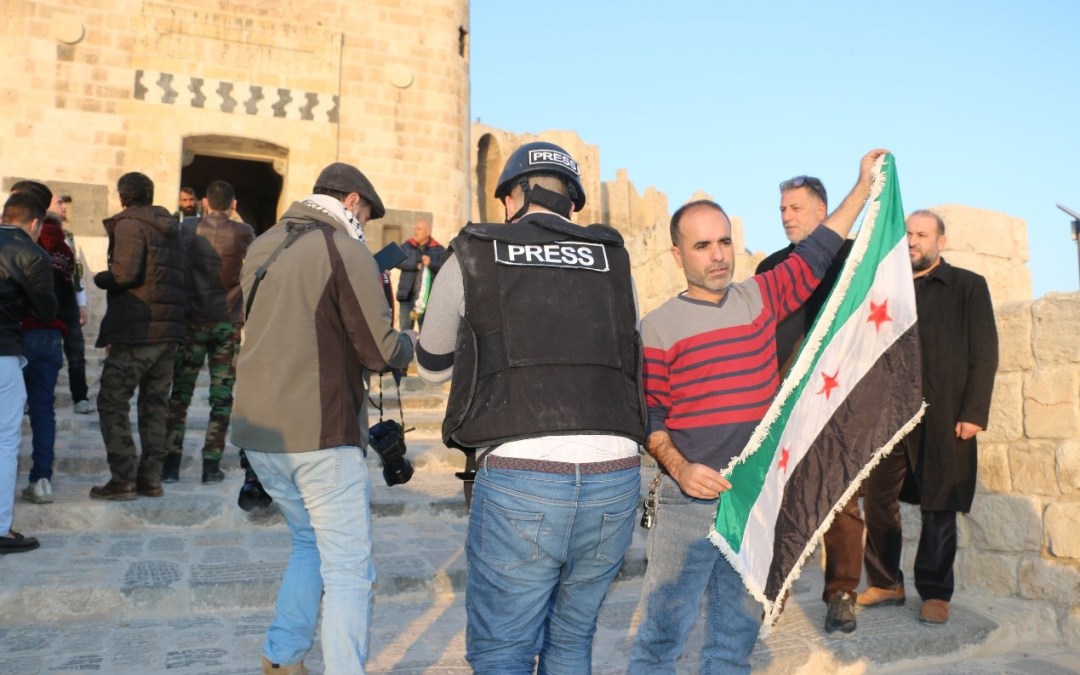
The forces of “Operation Deterrence of Aggression”, (عملية ردع العدوان) a joint operations room led by Hay’at Tahrir al-Sham (HTS) and comprising a group of opposition factions and the National Army in northwestern Syria, succeeded in entering the city of Aleppo just two days after the battle began. The swift and unexpected liberation facilitated a transfer of authority within the city without widespread chaos or destruction. The rapid withdrawal of regime forces prevented intense military clashes, leaving all government offices and departments intact, including the Aleppo Museum and its iconic citadel.
Despite aerial bombardments by Assad regime forces and their Russian allies in the days following the city’s liberation, these attacks ceased after the opposition forces under “Operation Deterrence of Aggression” expanded their control over most Syrian cities. This was marked by the collapse of regime forces and Bashar al-Assad’s flee to Moscow, culminating in the declaration of opposition control over Damascus on the 8th December 2024. This event marked the beginning of a new chapter in Syria’s modern history, the contours of which remain uncertain. (Image 2)

- The State of Antiquities in Aleppo During Assad Regime Control
After the Assad regime took control of Aleppo in 2016, the state of the city’s antiquities and the old city became a matter of great concern for experts due to the massive destruction. There was significant apprehension regarding the regime’s ability to professionally and objectively handle this critical issue, especially given the lack of resources and specialized personnel.
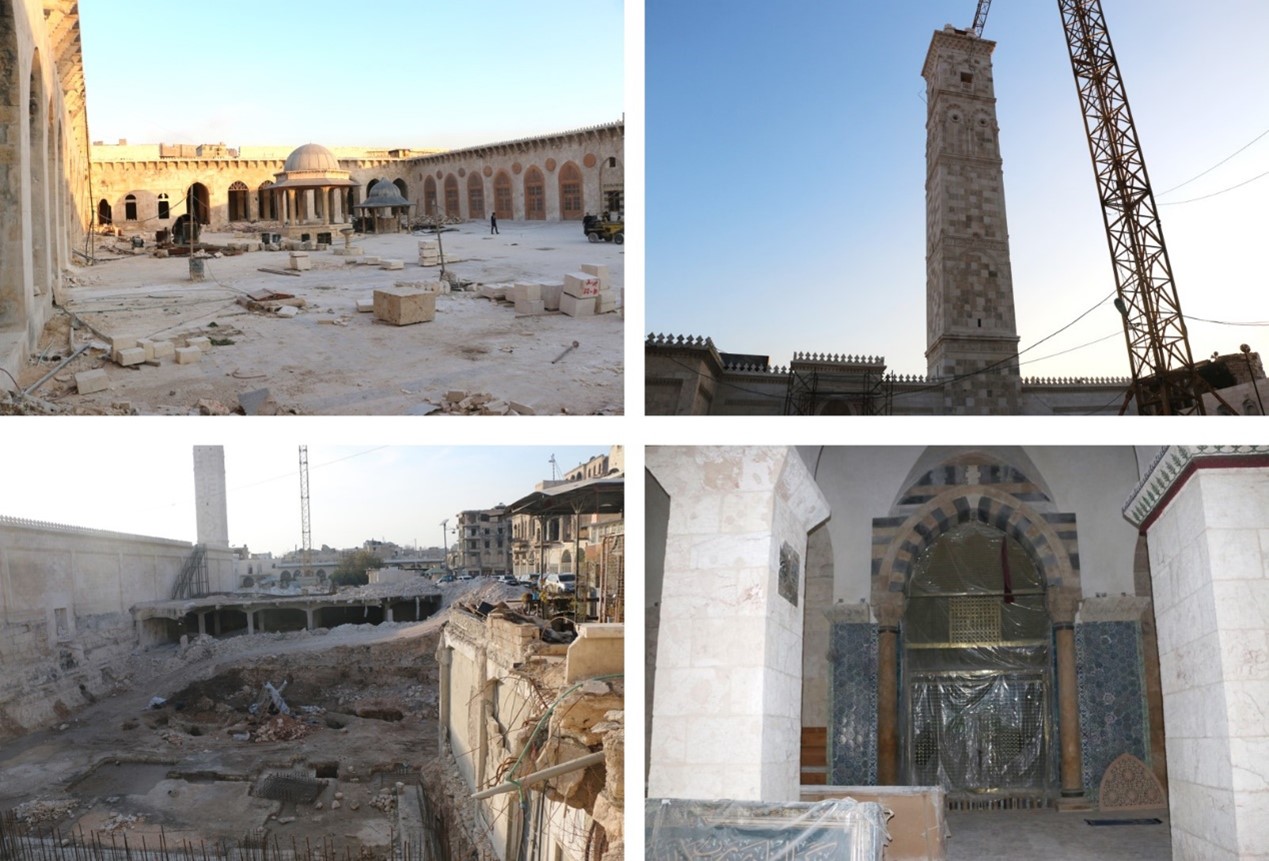
The regime, however, quickly sought to exploit the heritage sites in Aleppo to gain political advantages, similar to what happened in Palmyra, initiating a limited number of restoration and rehabilitation projects for some of Aleppo city’s less damaged markets and started restoring and rebuilding the minaret of the Umayyad Mosque in Aleppo. The projects were carried out through partnerships and funding from several international organizations, some of which aimed to normalize relations with the Assad regime without addressing Syria’s prolonged humanitarian crisis since 2011.
These restoration efforts took place under unsuitable conditions, with Aleppo’s antiquities suffering from a shortage of specialized personnel and proper studies. The most criticized aspect of these efforts was their disregard for the needs of the local community, which was entirely excluded from participating in the restoration of its own heritage. Despite repeated calls to correct past mistakes, local and international experts were ignored. Syrian archaeologists and organizations urging adherence to international laws and conventions on restoration were also dismissed.
One prominent example of these violations was the restoration of the Great Umayyad Mosque in Aleppo, where additions were made that disrupted the mosque’s cultural context. Multiple warnings highlighted these errors, including a statement by heritage expert Mohammad Nabhan, who called for saving the mosque and other historical buildings being restored improperly.
Additionally, the February 6, 2023, earthquake caused further damage to the already vulnerable historical buildings. Emergency stabilization work was carried out to mitigate the damage, including efforts at the Aleppo Citadel. (Image 3)

- Assessment of the Current State of Aleppo’s Antiquities After Liberation
Following the Syrian revolution’s takeover of Aleppo and the withdrawal of regime forces without fighting, public properties, including the Aleppo Museum, were preserved without any damage. Over the past few days, the museum has not been subjected to any violations and is now well protected.
The museum staff and the Directorate of Antiquities have returned to their duties, with no changes to the administrative structure of the Directorate or the museum. Additionally, guards from the “Deterrence of Aggression” forces are working alongside the museum’s original security team to provide protection and secure the museum during this transitional phase. (Image 4)

- Aleppo Citadel
As for the Aleppo Citadel, it remains closed under the management of military operations at the time of writing this report, with access denied even to staff from the Directorate of Antiquities and the citadel’s administrative team.
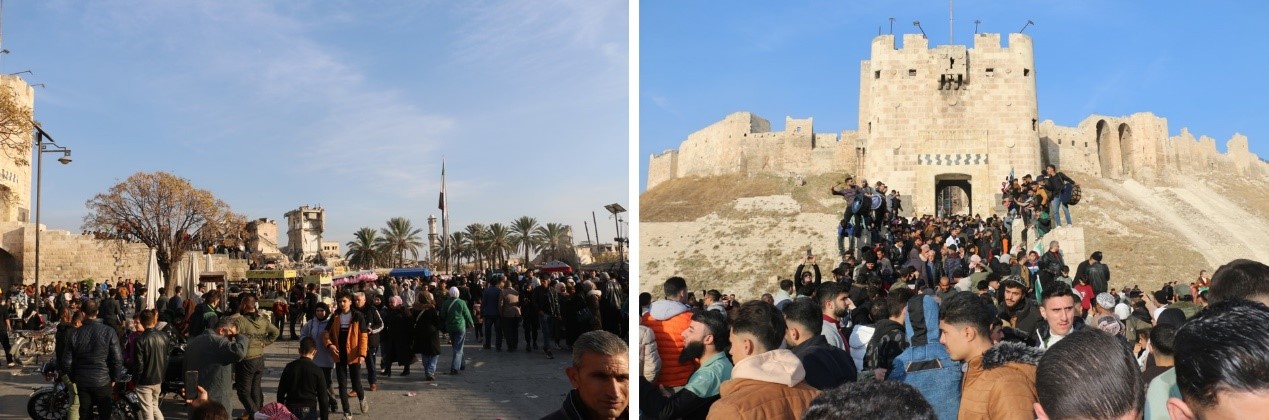
Meanwhile, the citadel’s square and surrounding area have become a central hub for victory celebrations and freedom festivities. Residents of the city and displaced individuals from other regions gather daily to view the citadel, celebrate in its vicinity, and take commemorative photos with their citadel as a symbol of triumph. (Image 5)
- The old city of Aleppo
As for the old city, no violations or damages have been recorded during this phase. However, it is noteworthy that several restoration, rehabilitation, and emergency stabilization projects have been undertaken to support damaged parts of certain buildings. These projects have been funded by various international entities, including the United Nations, the Aga Khan Foundation, the Japanese government, the Sultanate of Oman, the Directorate of Antiquities, and the Directorate of Endowments.
Some of these projects were in progress but have currently been halted due to recent events and remain incomplete. It is uncertain whether the organizations overseeing these projects, particularly international ones, will resume their work given the new political changes.
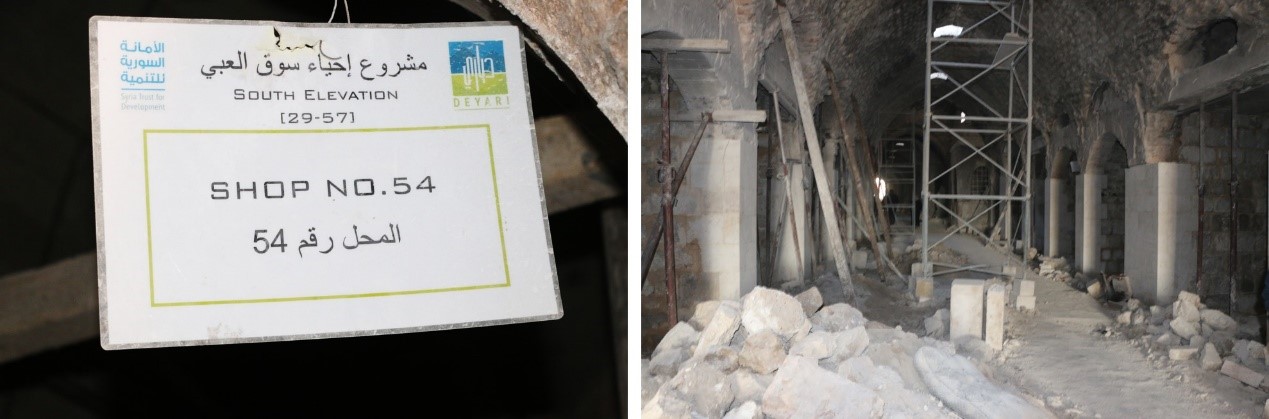
It is worth mentioning that these projects were somewhat politicized, with some being carried out in partnership with the “Syrian Trust for Development,” an organization indirectly linked to Asma al-Assad, who no longer holds any place in the new Syria. (Image 6)
- Key Restoration Projects Underway in Aleppo
- The Walls of Aleppo Citadel: Stabilization work is being carried out to address the damage caused by the February 6 earthquake. This project is funded by the Aga Khan Foundation for Cultural Services and is being implemented by the Ministry of Tourism. (Image 7)

- The Umayyad Mosque and Its Minaret: Restoration work is being funded by the Republic of Chechnya and executed by the Military Construction Department. (Image 8)
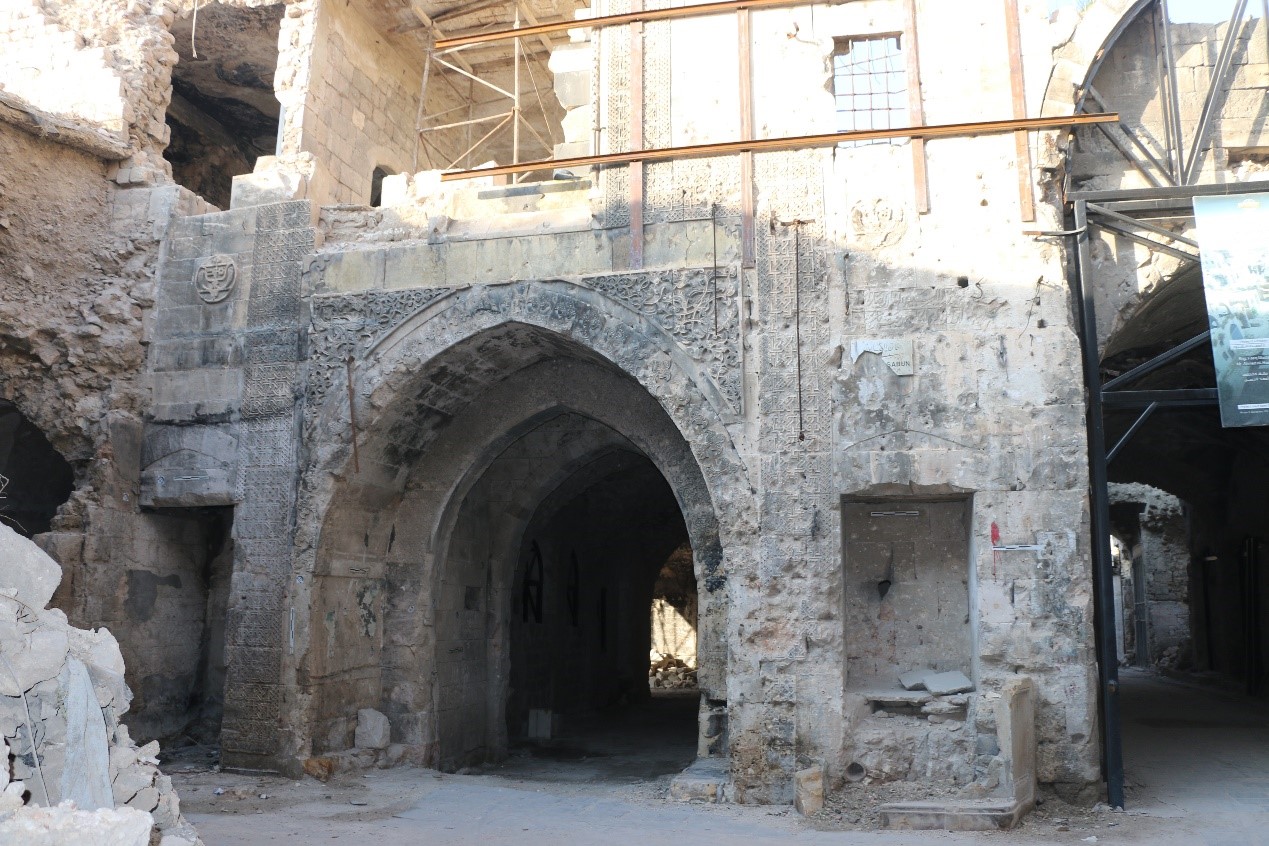
- Khan Al-Saboun (Soap Khan): Restoration work is funded by the Aga Khan Foundation for Cultural Services and ALIPH. (Image 9)
- Revitalization of Al-Abyad Market: This project is overseen by the Diari Group and the Syrian Trust for Development. (Image 10)

- Al-Halawiya Mosque and School: Restoration work is funded by the Aga Khan Foundation for Cultural Services and ALIPH, with implementation by the Directorate of Endowments and the General Directorate of Antiquities. (Image 11)

- Museum of Popular Traditions (Ajqabash House) and City Memory Museum (Ghazzala House): Restoration work is funded by Oman and is being carried out in phases.
- Assessment of the Current State of the Aleppo Museum
The Aleppo Museum faced numerous risks in earlier stages due to its location near conflict zones. As a result, several temporary protective measures were implemented, including covering the sculptures displayed in the museum gardens and securing the storage areas. (Image 11)

In 2013, valuable artifacts were transferred to the Central Bank for safekeeping, and in 2015, a large collection from the museum was moved to the storage facilities of the Damascus Museum. Although the museum’s artifacts were not directly damaged by the war, the building itself suffered significant damage due to explosions nearby and direct shelling on multiple occasions. The building also sustained additional damage from the February 6, 2023 earthquake.
After the Assad regime regained control of the city, the Aleppo Museum reopened in 2019, but only two exhibition halls were rehabilitated out of eight. The transferred items were returned to the museum to complete the new display. Meanwhile, the exhibition hall for Assyrian and Aramean sculptures on the ground floor was converted into storage for archaeological pieces, which were moved from other locations such as the Museum of Popular Traditions. Many of these items were looted in 2013, and others, including study pieces from excavation sites in eastern Aleppo, are now stacked randomly without proper storage or classification, leaving them vulnerable to environmental factors. The upper exhibition halls are in a chaotic state and are almost abandoned, with significant damage from both the war and the earthquake.
This disorganization and decline in preservation are due to the lack of professional staff, including archaeologists, and the lack of responsibility from the General Directorate of Antiquities in maintaining the museum.
- Risks and Challenges for the Next Phase
Although the political and administrative situation for the next phase has not been fully defined, with the establishment of a transitional government (caretaker government) just two days after the fall of the Assad regime, several international bodies, specialists, and heritage experts have quickly engaged with archaeologists working at the General Directorate and other relevant heritage institutions to develop plans and consultations to support the future of archaeological heritage. However, these communications lack organization and are being carried out individually, without a clear or structured plan for managing the current phase. Furthermore, there is a real concern that the previous approach used by the General Directorate of Antiquities and Museums will persist. This approach, which excluded expertise and civil society organizations outside the Directorate’s control, did not consider the needs and interests of local communities in archaeological areas.
As for Aleppo, life is returning to the city faster than expected. Thousands of residents, previously displaced in the northern Syrian camps, have rushed to visit the city and inspect their homes, some of which are partially or completely destroyed, while others are still intact but abandoned due to their forced departure from fear and persecution. This rapid return has introduced new challenges that need to be addressed. One of the primary challenges is that all of the displaced people will return to live in their homes within the old neighborhoods of Aleppo, which are currently unfit for habitation. This will require them to carry out cleaning and restoration work on their homes, which may affect the historical urban fabric of these neighborhoods, especially in the absence of strong archaeological oversight during this phase.
Additionally, the task of monitoring restoration works will be exceedingly difficult due to the large scale of the historical city, the shortage of qualified personnel, and the limited experience of available staff after the migration of many professionals. It is also worth noting that the previous laws imposed by the state did not ethically address the needs of the local community, which now hopes to be fairly treated by the new authority.
The second challenge lies in the ongoing projects that were halted due to the regime change and the fall of the previous government. The fate of these projects must be clarified, and an assessment of their progress should be carried out to determine the next steps for completing the work in case the funding organizations stop their support.
Another challenge is the future of the staff at the Directorate of Antiquities: will they continue working under the new administration? Will the current authority recruit new staff to fill the gap left by the migration of skilled workers? Will former employees who were dismissed or defected be allowed to return to their previous positions? How will the relationship between current staff and returning staff be managed?
- Recommendations
At this stage, we must make an additional effort to raise awareness about the importance of antiquities and historical sites and the need to preserve the current state of the old city of Aleppo until decisions are made to start the reconstruction process and rehabilitate the damaged buildings. The rehabilitation process should not be delayed in order to allow the return of residents to their homes and markets in the old city, which has already begun in a random and rapid manner after its liberation.
Efforts should be coordinated and unified among the various bodies involved in preserving Aleppo’s heritage. A joint working group should be established, drawing on the expertise of Syrian professionals both inside Syria and those displaced abroad. These experts should be given the opportunity to participate in saving and preserving the country’s cultural heritage, serving as an auxiliary force to the official archaeological bodies during this phase. This approach will help compensate for the lack of resources and personnel in the General Directorate of Antiquities and Museums, given the scale of the work ahead.